The academic landscape of 2026 is defined by a massive shift toward “Trustless Systems.” For a student embarking on a dissertation or a high-level research project, the challenge is no longer just finding enough data—it is proving that the data is authentic. As we navigate this digital era, the integration of Blockchain and Big Data has emerged as the most significant breakthrough for scholarly research. By combining the massive analytical power of Big Data with the immutable security of Blockchain, you can create a thesis that stands up to the highest level of scrutiny.
If you are feeling overwhelmed by the technical requirements of such a project, you might find yourself thinking, “I need an expert to do my assignment uk style with professional precision.” Utilizing a platform like myassignmenthelp can provide the necessary guidance to ensure your complex data structures are explained clearly while adhering to strict UK academic standards. This support allows you to focus on the high-level conclusions of your research while experts help refine the technical delivery of your arguments.
The Evolution of Research: Why Big Data Alone Isn’t Enough
For the past decade, Big Data was the king of the research world. It allowed students to analyze millions of data points, from social media trends to global climate patterns. However, Big Data has always suffered from a “centralization” problem. When data is stored in one place, it can be hacked, deleted, or manipulated. In an era where “fake news” and “data tampering” are common concerns, a thesis built on traditional Big Data can be questioned by professors and peer-reviewers.
Blockchain changes the game by introducing Decentralization. Instead of storing your research data on a single hard drive or a private cloud server, Blockchain technology distributes the data across a network of computers. Every time a new piece of data is added to your research, it is “timestamped” and linked to the previous block. This creates a permanent, unchangeable record of your research process.
Understanding the Technical Synergy
To successfully integrate these two technologies in your thesis, you must understand how they work together. Think of Big Data as the “Content” and Blockchain as the “Registry.”
- Volume and Velocity: Big Data tools like Hadoop or Spark handle the massive scale of your information.
- Verification and Trust: Blockchain acts as the security guard, ensuring that the data you collected on day one of your research is exactly the same as the data you are presenting in your final defense.
| Feature | Big Data Capability | Blockchain Value-Add |
| Data Storage | Stores petabytes of raw info. | Stores the “hash” (digital fingerprint) of the info. |
| Processing | High-speed analytical processing. | High-security validation. |
| Security | Firewall and encryption based. | Consensus-protocol and immutability based. |
| Transparency | Restricted to the researcher. | Auditable by any committee member. |
Building Your Thesis Methodology
When you sit down to write your methodology chapter, you need to explain how you will bridge these two worlds. This is often where the technical difficulty spikes. You aren’t just writing an essay; you are designing a digital system. Many students struggle with the coding required to link a Big Data lake to a Blockchain node.
If you find that the technical implementation is stalling your progress, seeking programming assignment help can be a strategic move. This ensures that your Python or Solidity scripts are optimized and that your data architecture is logically sound. With the coding handled by specialists, you can dedicate your time to interpreting what the data actually means for your specific field of study.
Step-by-Step Integration Guide for Researchers
To make your thesis rank as a “First Class” piece of work, follow this structural flow in your methodology:
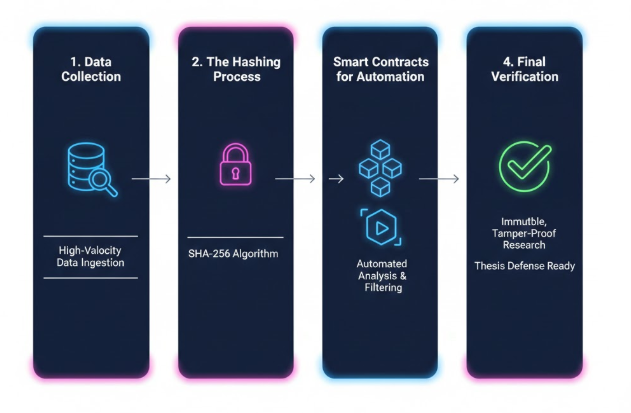
1. Data Collection (The Big Data Layer)
Start by identifying your data sources. Whether you are scraping financial markets or collecting medical records, you need a system that can handle “High-Velocity” data. In 2026, researchers are using AI-driven scrapers that automatically clean the data as it arrives.
2. The Hashing Process
You don’t put all your “Big Data” directly on the Blockchain (this would be too slow and expensive). Instead, you use a “Hashing Algorithm.” This turns a massive file into a short string of characters. You record this string on the Blockchain. If even one letter in your original file changes, the hash will no longer match, proving the data was tampered with.
3. Smart Contracts for Automation
Use Smart Contracts to automate your analysis. For example, you can write a piece of code that says: “If the data from the hospital reaches 1,000 entries, automatically run a regression analysis.” This removes human bias from your thesis, making your results scientifically superior.
The 2026 Shift: Ethical Research and Privacy
A major theme in modern dissertations is Data Ethics. With the rise of GDPR and other privacy laws, researchers must be careful with personal information. Blockchain offers a solution called Zero-Knowledge Proofs (ZKP).
Imagine you are doing a thesis on student grades. You need to prove that “Student A” got an “A+,” but you aren’t allowed to show their name or ID. With Blockchain integration, you can prove the grade is real without ever revealing the student’s identity. This level of privacy protection is exactly what university ethics boards are looking for in 2026.
Comparison of Traditional vs. Blockchain-Integrated Thesis
To help you visualize the impact, consider the following table:
| Research Element | Traditional Thesis Approach | 2026 Blockchain-Big Data Approach |
| Data Provenance | “I saved this on my Google Drive.” | “This data is verified on the Ethereum Ledger.” |
| Bias Control | Manual filtering by the student. | Automated filtering via Smart Contracts. |
| Reproducibility | Difficult for others to recreate. | High; others can verify the hash logs. |
| Cybersecurity | High risk of data loss or corruption. | Zero risk due to decentralized backups. |
Overcoming the “Speed” Myth
A common misconception among students is that Blockchain is too slow for Big Data. While this was true in 2020, the 2026 research environment utilizes “Layer 2” scaling solutions. These are secondary networks that process thousands of data points per second before settling the final result on the main Blockchain.
In your thesis, you should discuss Sidechains or State Channels. These allow you to perform heavy data mining at high speeds while still maintaining the “Trust” of the main network. Mentioning these technical nuances will show your professors that you are at the cutting edge of tech.
Why This Topic Ranks High for Future Careers
Choosing to write your thesis on the integration of Blockchain and Big Data isn’t just about finishing university; it is about building a professional brand. The job market is currently desperate for “Data Architects” who understand decentralized systems.
- Financial Services: Use these systems for fraud detection.
- Healthcare: Use them for secure patient record sharing.
- Supply Chain: Use them to track products from factory to consumer.
By documenting this integration in your dissertation, you are essentially creating a portfolio that proves you can handle the most complex problems in modern business.
Common Challenges and How to Solve Them
Despite the benefits, this path is not without obstacles. You will likely face three main hurdles:
- Complexity: Explaining “Consensus Algorithms” in a way that a social science professor can understand.
- Cost: The price of “Gas Fees” when recording data on a public blockchain.
- Storage: Big Data is heavy; Blockchain is light.
The Solution: Use a Private or Consortium Blockchain. This allows you to run the network for free on your university’s servers while still getting all the security benefits of decentralized technology.
Final Thoughts for the Modern Researcher
Integrating Blockchain and Big Data into your thesis is a bold move that signals your readiness for the future. It moves your research from a simple “report” to a “validated system of truth.” In 2026, the students who succeed are not just the ones who read the most books, but those who can master the digital tools that define our world.
As you build your framework, remember to keep your language clear and your data points verified. If the technical coding or the structural layout becomes a barrier to your success, don’t hesitate to reach out for professional support. Using experts to help refine your presentation or handle complex coding tasks ensures that your vision is realized without the stress of technical failure.
The future of data is here. It is decentralized, it is massive, and it is waiting for you to analyze it.
Frequently Asked Questions
How does blockchain improve big data research?
Blockchain adds a layer of permanent, verifiable trust to massive datasets. By recording digital “fingerprints” of your research data on a distributed ledger, you can prove that your findings have not been altered or tampered with since the point of collection.
Is it difficult to include blockchain in a dissertation methodology?
While technically advanced, it can be integrated by using a “hybrid” approach. You can store your large files on standard cloud systems while using blockchain only to log the verification hashes and automate analysis through self-executing code, keeping the process efficient.
Can blockchain protect participant privacy in a thesis?
Yes, it enables secure data sharing through advanced cryptographic methods. Techniques such as zero-knowledge proofs allow you to verify the validity of personal information or sensitive records without actually revealing the private details of the participants involved.
What are the main challenges of this technical integration?
The primary hurdles include the high computational energy required for some networks and the “scalability” gap between large-scale data processing and ledger recording speeds. However, modern research often solves this by using private networks or secondary processing layers.
About the Author
Ella Thompson is an academic consultant and lead researcher at MyAssignmentHelp. With a
focus on the intersection of emerging technologies and higher education, Ella specializes in helping students navigate the complexities of modern research methodologies and digital data integrity.